


AI Education: The Gap Between Knowing AI and Applying AI

We are living in a time when learning to use AI has become almost essential for professionals and businesses. People are experimenting with ChatGPT, exploring AI tools and learning how to write prompts. Yet, I believe there is a significant gap between knowing how to use AI and knowing how to apply AI effectively.
Using an AI tool is relatively easy. The real challenge lies in understanding what to ask, how to structure a problem, how to evaluate the response and how to turn the output into something useful. This requires more than familiarity with technology. It requires clarity of thought, an understanding of the business context and the ability to work with AI systematically.
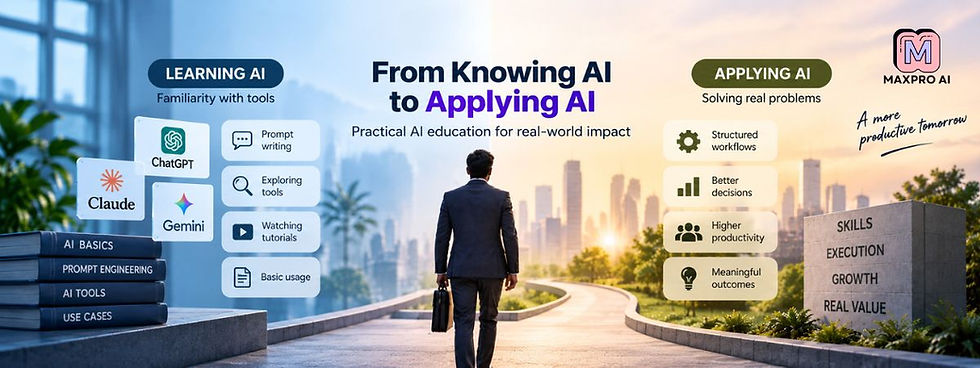
Over the years, I have seen how professionals develop expertise through experience, problem-solving and continuous learning. AI is now adding a new dimension to that process. The question is no longer simply whether someone knows how to use ChatGPT. It is whether they can integrate AI into their work to improve productivity, decision-making and outcomes.
This is why I believe AI education should move beyond tool demonstrations and prompt-writing exercises. It should help people understand how to identify opportunities, structure tasks, verify information and build practical workflows using AI.
As we move from individual AI tools towards conversational AI platforms, AI agents and intelligent workflows, the ability to think clearly and work collaboratively with AI will become increasingly important.
At MAXPRO AI, my focus is on making AI education practical and accessible. Through my work in building AI products such as Mergenta and Vyakarni, I continue to explore how technology can solve real problems and create meaningful value.
The future of AI education is not just about learning what AI can do. It is about learning how to make AI useful.
What do you think is the biggest gap in AI education today: understanding the technology or applying it to real-world problems?


Comments